


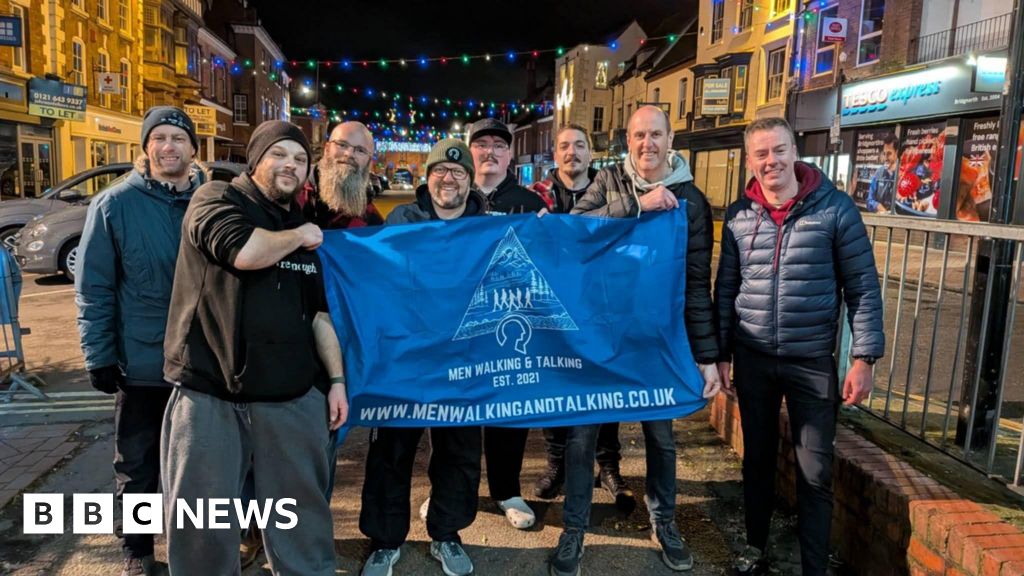
As dusk settles over Telford, a group of men gather in a shopping street adorned with twinkling Christmas lights. Standing shoulder to shoulder, they hold a banner that reads, “Men Walking & Talking.” This scene captures a growing movement reshaping how men engage with their mental health, one step at a time.
Men Walking & Talking: A Path to Emotional Resilience
In just four years since its inception by Dan Reid, Men Walking & Talking (MWAT) has become a significant initiative in the UK, with over 50 branches spread nationwide. What began as a casual meetup for a few individuals has burgeoned into a supportive community, attracting more than 20,000 participants in 2025 alone, more than double the number from the previous year.
Breaking Silence: The Transformation of Male Mental Health Discourse
The escalating participation in MWAT is emblematic of a broader cultural shift. According to a recent study conducted by the Mental Health Foundation, 70% of men in the UK admit to struggling with mental health issues but feel unable to share their feelings. Reid’s initiative seeks to dismantle this silence, offering a safe space where men can talk openly, or simply enjoy shared company while walking.
Mark Taylor, one of MWAT’s directors and a group leader in Kenilworth, reflects on this transformative moment. “Men often feel ostracized when it comes to discussing their emotions. Our walks provide a judgment-free environment,” he explains. Taylor notes that the informal nature of walking alongside someone, without the pressure of eye contact, allows deeper conversations to flourish. “It’s a different vibe than sitting across from someone in a pub,” he adds. “Our motto is: ‘No man should walk his hardest miles alone.’”
The Power of Group Dynamics
Despite the stigma surrounding mental health, MWAT has successfully cultivated numerous branches, with 15 new groups established in 2024 and an additional 21 launched in 2025. These gatherings blend physical activity with emotional support, inviting men to engage in conversations at their own pace. Danny Bailey, who participates in both Kidderminster and Bridgnorth groups, shares how the community has benefited him personally. “After my divorce, I found myself feeling isolated,” he recalls. “The group has become a lifeline.”
Community Connection: The Backbone of Mental Wellbeing
Men Walking & Talking exemplifies how community initiatives can address critical mental health issues. Groups are forming rapidly across various locations, including the West Midlands, Cheshire, and Warwickshire. As the initiative grows, so does the diversity of conversations and experiences shared among participants. A survey conducted by the National Institute for Health Research found that peer support among men not only enhances emotional resilience but also fosters a sense of belonging.
Discussions often pivot around shared experiences such as:
- Stress from work and family obligations
- Navigating relationships and breakups
- Loneliness exacerbated by the COVID-19 pandemic
- Mental health stigma and barriers to seeking help
Unpacking Barriers: The Role of Culture
Dr. Emma Porter, a sociologist specializing in gender and mental health, underscores the significance of such initiatives. “Cultural expectations often dictate that men should be stoic and strong, leading to emotional suppression,” she notes. “Groups like MWAT challenge these norms, allowing men to express vulnerability in a supportive environment.” The gains are significant; studies indicate that men who participate in similar groups report lower levels of anxiety and depression.
Steps Forward: The Future of MWAT
With seven new walks set to commence in early 2026, the future of MWAT looks promising. Reid is committed to extending the reach of this movement, stating, “We want to bring this brotherhood into more communities, to continue reaching men where support is most needed.” This relentless drive is not merely about numbers; it’s about reshaping a culture where talking about mental health is as normalized as discussing sports or weather.
The impact of MWAT is tangible. It has sparked conversations in homes, workplaces, and even among friends, making mental health an integral part of life rather than a taboo subject. Taylor reinforces this ethos: “Our goal is to make sure every man knows he has a place to turn—someone to talk to who understands.”
As the men walk, laughter intertwines with candid discussions about life’s challenges. In a world where distance can feel lengthy, MWAT offers a pathway to genuine connections—one step at a time. The Christmas lights twinkle overhead, but for these men, the true illumination lies in the bonds formed through shared journeys, reminding them that they are never truly alone.
Source: www.bbc.com

